


Please Leave Us A Message
Privacy statement: Your privacy is very important to Us. Our company promises not to disclose your personal information to any external company with out your explicit permission.

In heavy-duty industrial components, structural integrity begins at the microstructural level. While dimensions and machining tolerances are visible, the internal grain flow of steel largely determines fatigue resistance, crack propagation behavior, and long-term reliability.
For critical Forgings used in gearboxes, Mining Machinery, power generation, and large bearing systems, grain flow is not a secondary effect—it is a structural advantage engineered through the forging process.
This article examines how grain flow forms in Open Die Forging and Ring Rolled Forgings, and why it significantly improves mechanical performance compared to non-directional structures.
Unlike isotropic cast structures, forged materials develop a fibrous internal structure aligned with the component geometry. This directional alignment directly influences fatigue behavior.
In open die forging, large billets are compressed between flat or shaped dies without fully enclosing the material. For large forging shaft components:
The result is a continuous longitudinal grain flow pattern.
Shafts in industrial transmission systems are subjected to torsion, bending, and cyclic loading. When grain flow follows the shaft axis:
This is particularly important in gearbox and heavy drive applications.

Conceptual illustration generated for reference
Ring Rolled Forgings develop a different but equally important grain structure. The process begins with a pierced preform, which is expanded radially and axially. During this expansion:
For large forging ring components used in bearings and gear rings, this alignment is critical.
Large rings experience radial stress, circumferential tensile stress, and repeated cyclic loading. When grain flow follows the circular geometry:
This is one reason Seamless Ring rolling is widely used for high-load rotating components.
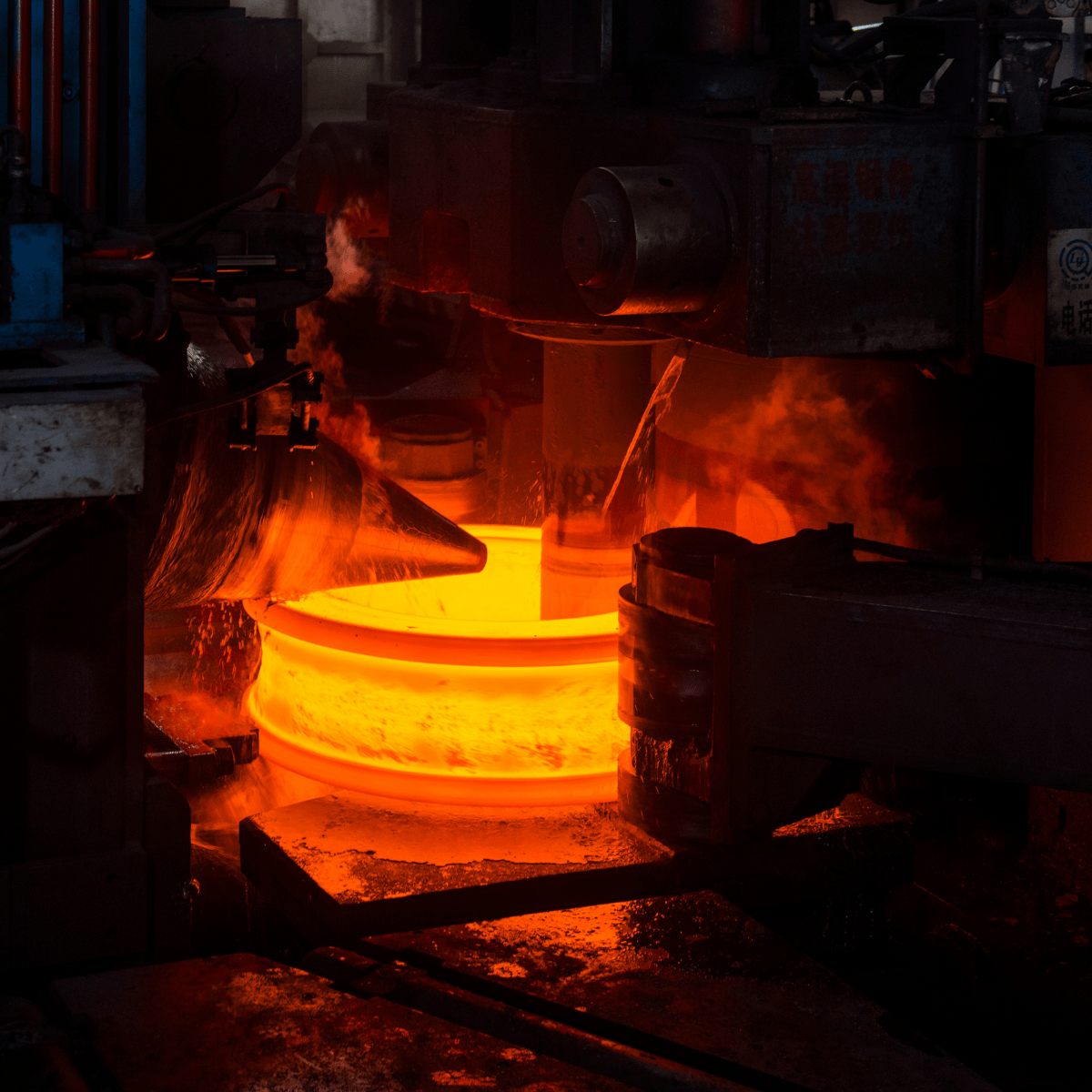
Ring Rolled Forging © Jiangyin Liaoyuan New Energy Co., Ltd. – Original production photo
Cast components solidify from liquid metal. Their grain structure:
In contrast, forged components:
For heavy-duty applications such as mining gear rings or industrial gearbox components, directional grain flow provides a measurable improvement in fatigue life.
Large cross-sections introduce additional considerations. For thick forgings:
Inadequate deformation may leave coarse central grains or incomplete consolidation. Proper process design in open die forging ensures that strain distribution is sufficient to maintain grain continuity throughout the section. Similarly, in Ring Rolled Forgings, controlled radial reduction is necessary to maintain structural uniformity across wall thickness.
Fatigue failure typically initiates at surface defects, inclusions, or stress concentrations. Once initiated, crack propagation behavior determines component life. Directional grain flow:
In large rotating shafts and rings, this translates into longer service intervals and lower failure risk.
For large industrial parts such as Gearbox Shafts, Bearing Rings, slewing rings, mining drive components, and power generation shafts, the forging route is selected not only for shaping capability, but for internal structural optimization. Both open die forging and Ring Rolled Forgings are particularly suited to:
The internal structure becomes an engineered performance feature rather than a by-product of forming.
Grain flow is one of the most important structural advantages of forged Steel Components. In open die forging, grain alignment enhances axial strength and fatigue resistance in shafts. In Ring Rolled Forgings, circumferential flow improves structural performance in rings under rotating stress.
For heavy-duty industrial applications, this internal directionality significantly improves fatigue behavior, crack resistance, and long-term reliability. Understanding grain flow is therefore essential when evaluating manufacturing routes for large forged components.
Email to this supplier
Privacy statement: Your privacy is very important to Us. Our company promises not to disclose your personal information to any external company with out your explicit permission.
Fill in more information so that we can get in touch with you faster
Privacy statement: Your privacy is very important to Us. Our company promises not to disclose your personal information to any external company with out your explicit permission.